Installation starts long before the equipment arrives: with the site survey, from which the manufacturer draws the lift for the specific shaft. Below is what we measure, what the builder has to prepare and what customers ask most often.
What we measure
The shaft width and depth on every floor, because walls are rarely perfectly vertical. The pit depth from the floor of the bottom landing. The headroom: the distance from the floor of the top landing to the slab above. Floor heights, door openings, the wall material and the place for the controller cabinet. In an old shaft we also check the condition of the embedded parts and the machine room.
What the building must provide
A shaft built to the installation drawing: the dimensions for each model are on the "Series and parameters" page. A three-phase 380 V supply; the traction machine power ranges from 2.1 kW for 320 kg to 13.4 kW for 2000 kg at a speed of 1.0 m/s. In machine-room-less lifts, space is needed next to the top landing door for a controller cabinet of 185×2000×110 mm.
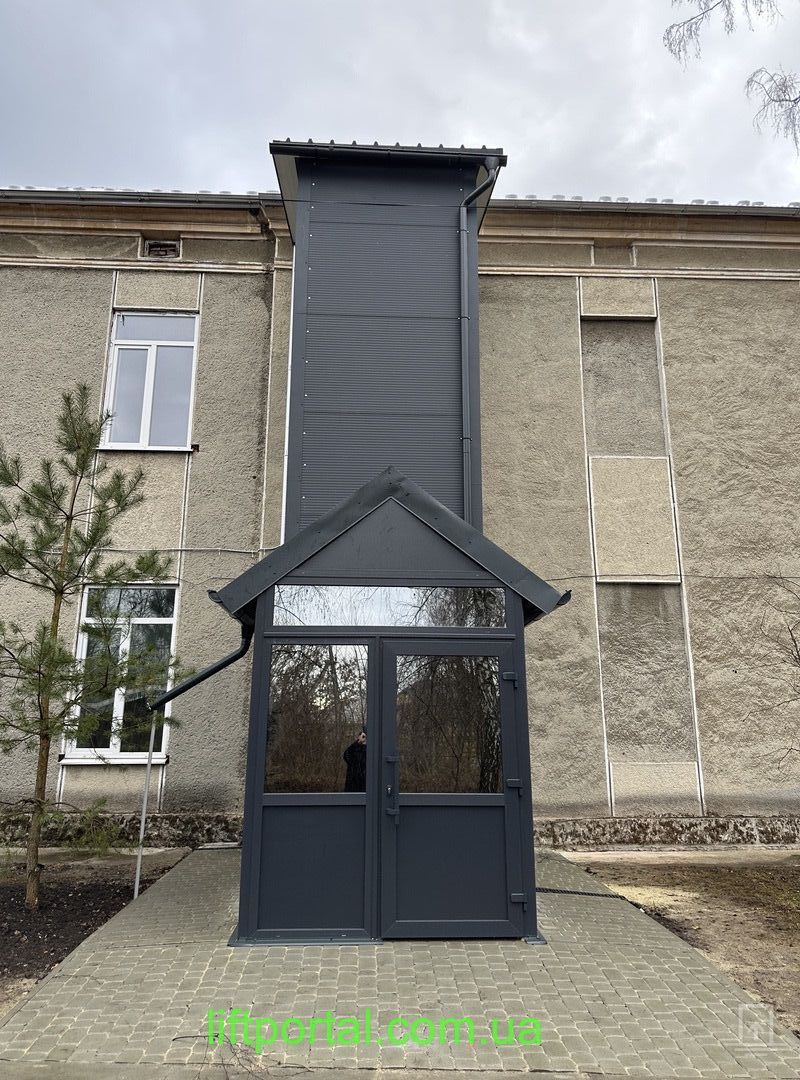
For lifts up to 1000 kg with cantilever suspension, one wall must be load-bearing: the guide rails are fixed to it. According to a note in the catalogue, for some models the front shaft wall with the door openings is completed after the doors have been installed. Where there is no shaft, one can be added: we design and build steel frames with glazing or sandwich panels ourselves.
How the work goes
After the survey we prepare the specification and the builder's work brief, the manufacturer produces the installation drawing, and the client approves it. Before the equipment arrives, the builders finish the shaft and bring in the power supply. Installation, commissioning and testing follow. Assembly, installation and final inspection are covered by our Module D certificate; for each lift we draw up a declaration of conformity and hand over the lift passport.
A lift is selected to suit the building and the load. The most expensive specification is rarely needed, and the cheapest sometimes turns out more expensive over its years of service.
Customer questions
Where are Izamet lifts made?
The current certificates name TEMAZI Ltd as the manufacturer of the Genesis, German R, German S and IZA models and the hydraulic IH models, with production in Dupnitsa, Bulgaria. For other equipment we state the manufacturer and the document in the quotation.
Why does the certificate say TEMAZI Ltd if the lift is an Izamet?
The certificate records the company that series-produces the lift, while the brand is named in the contract and the quotation. This is explained in detail on the "Documents for an Izamet lift" page.
What is the smallest pit an Izamet lift needs?
It depends on the model. According to the technical catalogue, with the additional safety system Genesis 12 needs 400 mm, Genesis 21 500 mm, and EnEf and German R 700 mm at a speed of 1.0 m/s. The certificate permits a reduced pit with compensating measures, which are part of the specification of such a lift.
Is a machine room mandatory?
No. All three types in the certificate are available both with and without a machine room. If there is already a room above the shaft, it is usually used.
How are the belts in the Genesis series maintained?
They need no lubricant. The certificate requires periodic visual inspection in line with the manufacturer's instructions, which include discard criteria, and we enter this inspection in the maintenance schedule.
Can an old lift be replaced in an existing shaft?
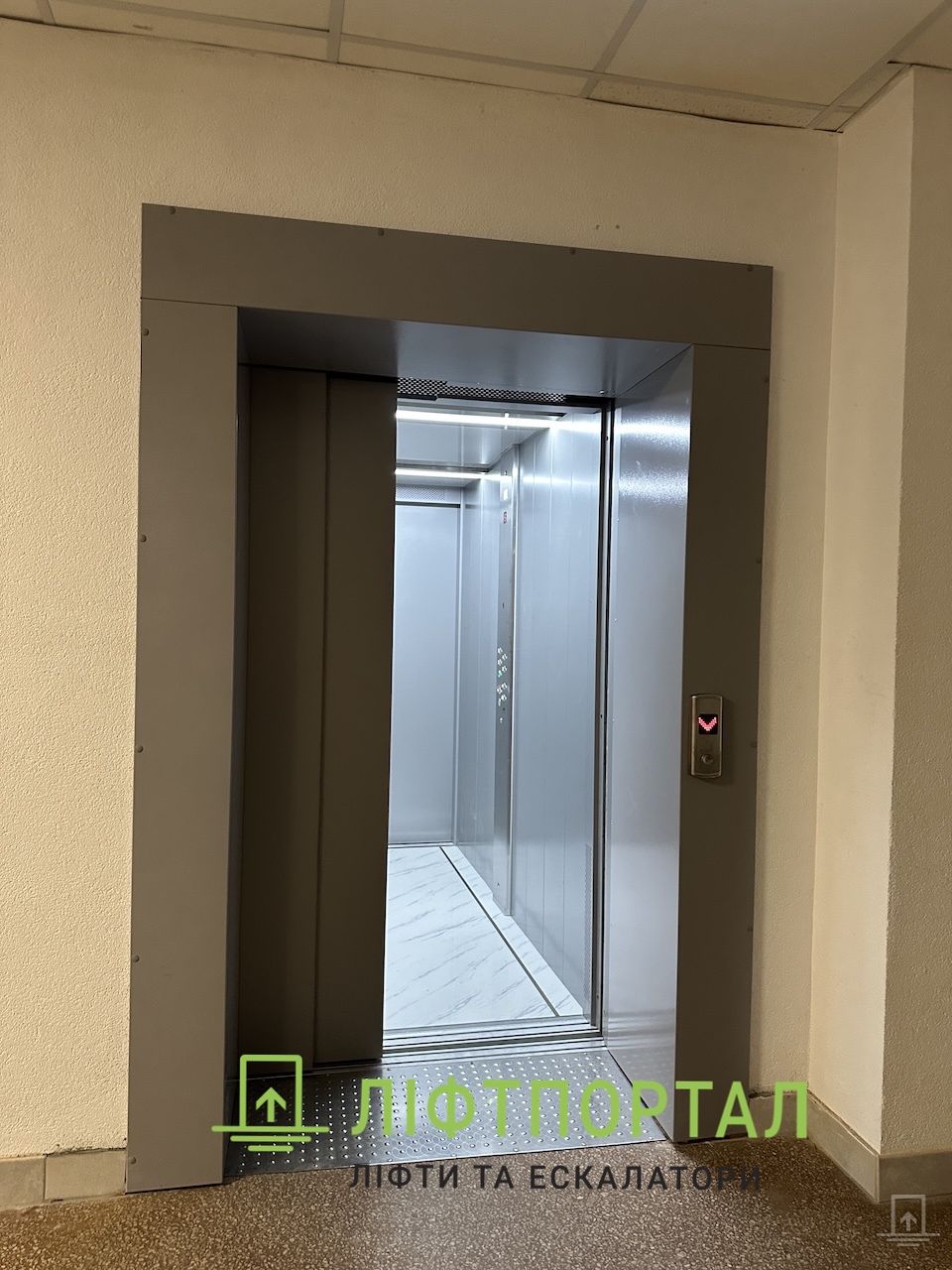
In most cases yes; the site survey gives the final answer. In Rozhniativ, during the replacement of a hospital lift, the landing doors were moved out onto the landing, which enlarged the car to take a hospital trolley.
What happens if the power fails?
We list the automatic rescue device (ARD), which brings the car to the nearest floor, as a separate line in the specification of an electric lift. In hydraulic lifts, according to the manufacturer's description, a battery system that brings the car to a landing is built in.
What documents does the client receive?
The lift passport, the declaration of conformity, the test report and copies of the certificates. The list with numbers and validity periods is on the "Certificates" page.
Your question may not be here. Write it in your request together with the shaft dimensions.
