The Swiss factory Diethelm Aufzüge AG in Lachen (canton of Schwyz) builds machine-room-less lifts with the drive mounted on the counterweight. Thanks to this layout, the factory's quotation for a 630 kg passenger lift states a 150 mm pit and 2420 mm headroom: dimensions with which a conventional lift does not fit in the shaft. We supply Diethelm lifts to order, install them and take them on for maintenance.
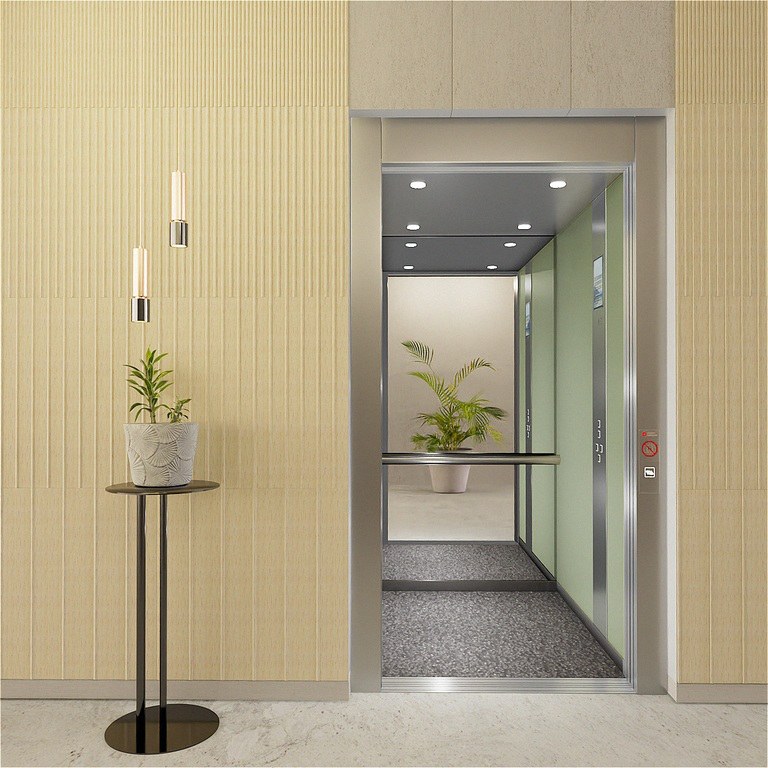
Who Diethelm is
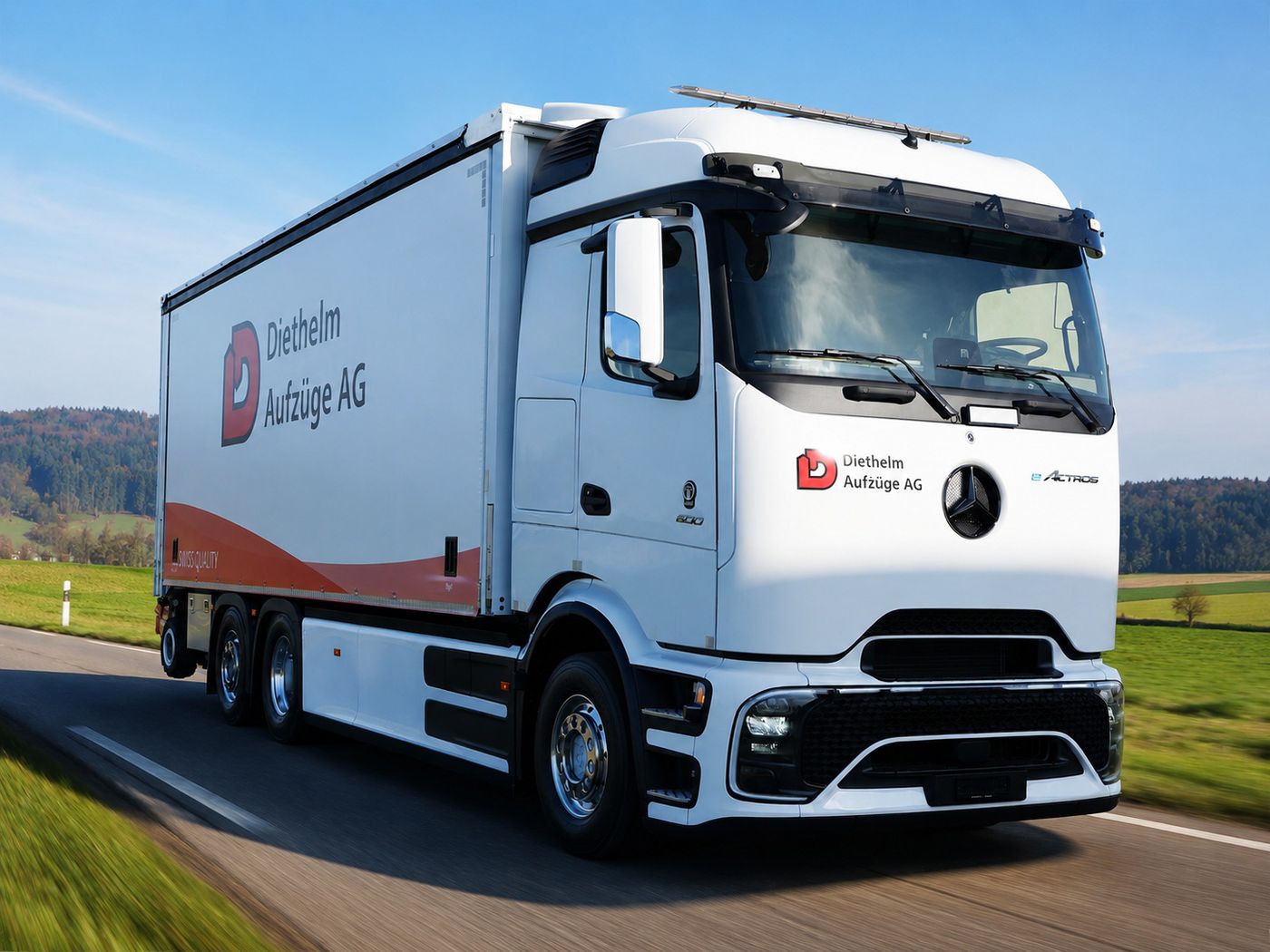
The company was registered in 1991. It is a family business: the Diethelm family runs it, and the second generation already works at the factory. According to the factory itself and the Swiss trade press, Diethelm has more than a hundred employees and produces about four hundred lifts a year. The factory cuts and bends sheet metal in-house, and it also develops and assembles its own controller.
The factory has been producing its own lifts since 2001 and has operated from a new plant in Lachen since 2013. The patent application for the drive on the counterweight was filed in 2006, and since 2017 Diethelm has fitted a controller built on its own circuit boards. The emergency communication system and the Smart Display are made by ONFUSE, a company belonging to the same family. In its quotations the factory states that it is a member of Swissmem, the Swiss industry association.
Diethelm works mainly for Switzerland. The factory's references include passenger lifts for 525-1600 kg, freight lifts up to 3200 kg and vehicle lifts for 3500 kg. All lifts run at 1.0 m/s.
Drive on the counterweight
In a conventional machine-room-less lift the traction machine is fixed in the upper part of the shaft and needs extra height above the car. Diethelm moved the drive onto the counterweight. The motor with its traction sheave travels with the counterweight and is powered through a travelling cable, while only diverter pulleys remain at the top of the shaft. The factory calls this solution patented and states that it reduces the transmission of drive noise to the building structure.
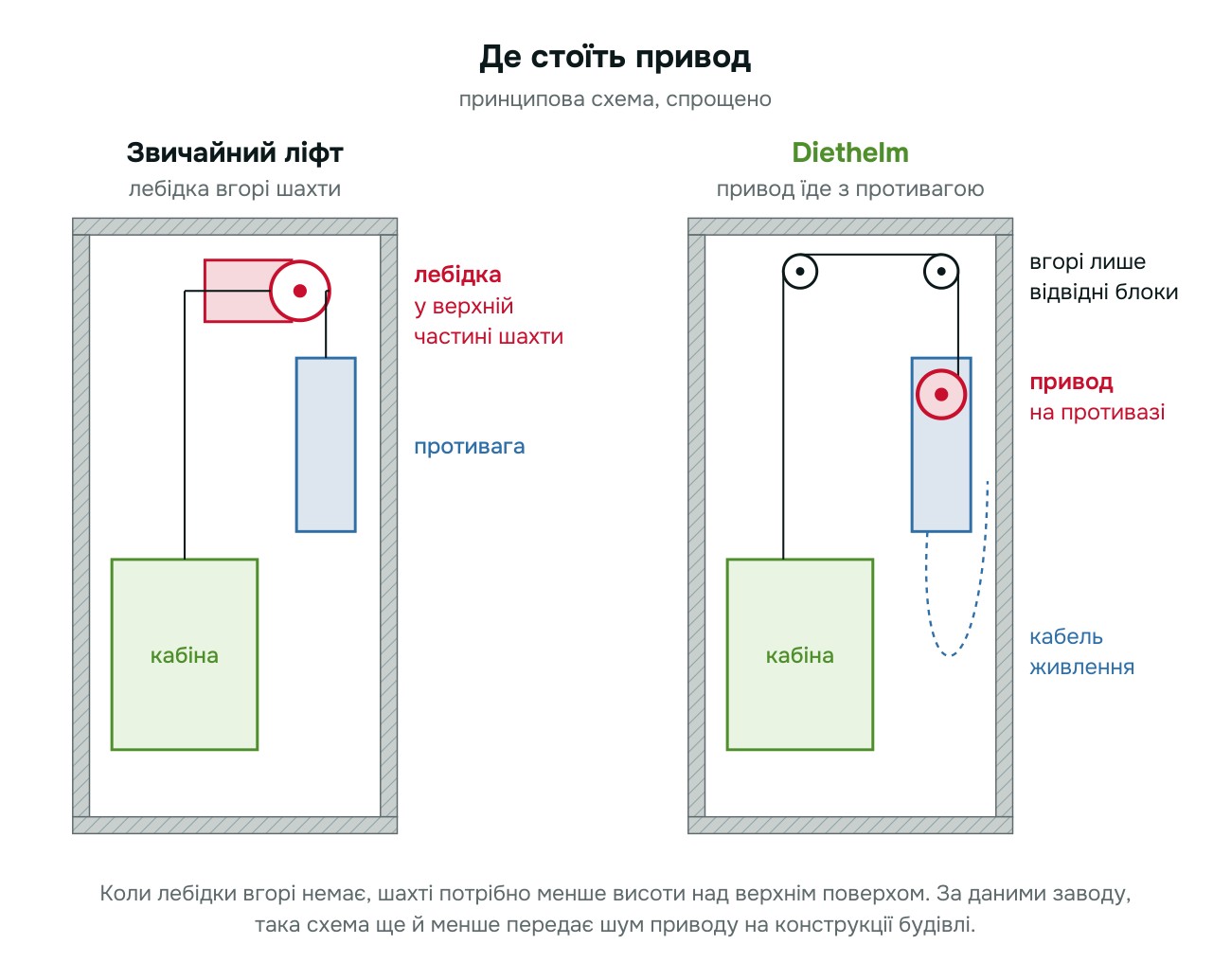
This is where the small dimensions come from. They have a page of their own: a lift with a 150 mm pit and low headroom.
What the lift consists of
| Component | Specification in the factory's quotations |
|---|---|
| Drive unit and variable frequency drive (VFD) | Ziehl-Abegg; in 630 kg lifts the operating power is 3.4 kW and the rated current 13 A |
| Landing and car doors | Wittur, stainless steel, aluminium sill, fire rating E120 |
| Controller | the factory's own design with a Kollmorgen processor, set up through a web interface |
| Display and call stations | Smart Display in the car, landing call stations built into the door frame |
| Emergency communication | ONFUSE, 4G VoLTE mobile network |
| Standards | EN 81-20, EN 81-50, EN 81-21, EN 81-28 |
The factory builds the car itself: ceiling and front wall in brushed stainless steel, side walls in a colour of your choice, a mirror on the rear wall, LED lighting. The controller cabinet is usually placed in the door reveal on the lowest floor, so it needs no separate room.
Shaft and car dimensions and finishes from three factory quotations are collected on the configurations page.
Which buildings it suits
A lift with the drive on the counterweight is designed first of all for buildings that already exist: the shaft has to fit within existing walls, and there is no spare room below or above it. These are residential buildings without a lift, historic buildings, and add-on shafts of glass and metal. A 1100 × 1400 mm car in a 1600 × 1750 mm shaft is accessible to a wheelchair user, so this solution also suits facilities that must become accessible without rebuilding the floor slabs.
In a new building a shallow pit and low headroom are usually not needed. There the factory calculates the lift for a standard shaft: in the 1000 kg quotation it is a 1600 × 2350 mm shaft with a 1100 mm pit. The factory also makes a panoramic lift with a glass car; in the quotation we received it had three stops and a 1600 × 1800 mm shaft.
What to know in advance
The factory is geared primarily to the Swiss market, so we agree delivery to Ukraine separately for each lift: the configuration, the production lead time and the shipping terms. There are no ready-made lifts in stock.
The safety components are certified, while the factory hands over the lift as a whole through individual acceptance. In Ukraine each such lift undergoes conformity assessment under the Technical Regulation on Lifts on site, after installation.
The standard rescue operation in a power failure is gravity-based and is limited by the car load. We agree a configuration with battery-powered rescue with the factory. How it works is explained on the page about installation, building requirements and rescue.
Diethelm uses its own controller and emergency communication system. The controller software is supplied under a licence for use, and the SIM card and the alarm call centre in Ukraine have to be arranged locally.
What we do
Our part of the work starts with the site survey of the shaft, and it is free. We take dimensions at several levels and photograph the pit and the top of the shaft, because wall deviations also matter for the drawing. Then we prepare the brief for the factory, agree its drawing with the client, arrange delivery from Lachen, install and commission the lift, carry out the conformity assessment and put the lift into service. After that we take it on for maintenance.
The key points are summarised in the brochure: Diethelm - LIFTPORTAL. Lifts with a shallow pit (PDF, 4 pages).
If your building has a shallow pit or little room above the top floor, leave a request with the shaft dimensions: we will check whether this solution fits.
