A Diethelm lift travels from Lachen as a set of assemblies, while the shaft, the electrical work and the conformity assessment are arranged here. Below we describe the work sequence, the building requirements under the factory's terms, how the rescue operation works without power, and answers to the questions that come up first in such a project.
Work sequence
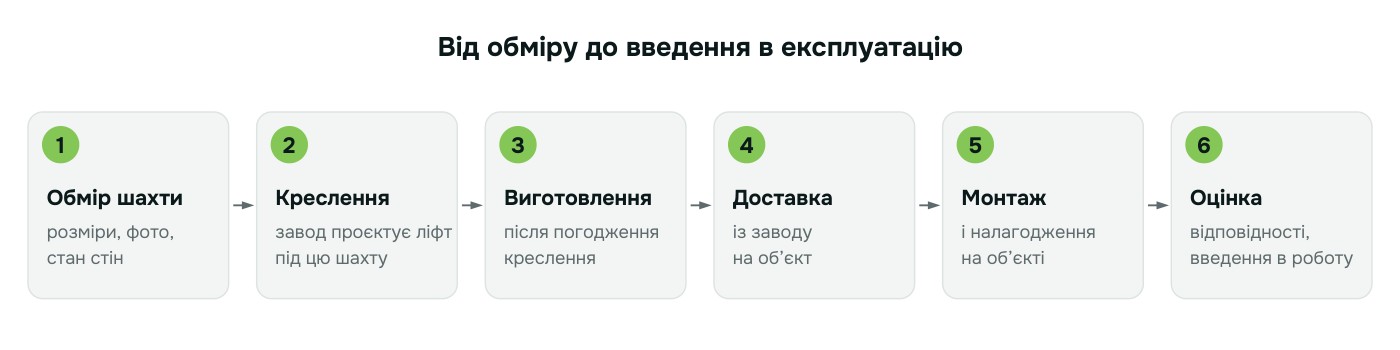
First we survey the shaft or the space for it and pass the dimensions to the factory. The factory designs the lift and sends an installation drawing; manufacturing starts once it has been approved in writing. The factory states the production lead time for each lift separately. The equipment is shipped on ex-works terms, so we arrange transport and customs clearance. Then come installation, commissioning, conformity assessment under the Technical Regulation on Lifts (Ukraine) and putting into service.
What to measure before the request
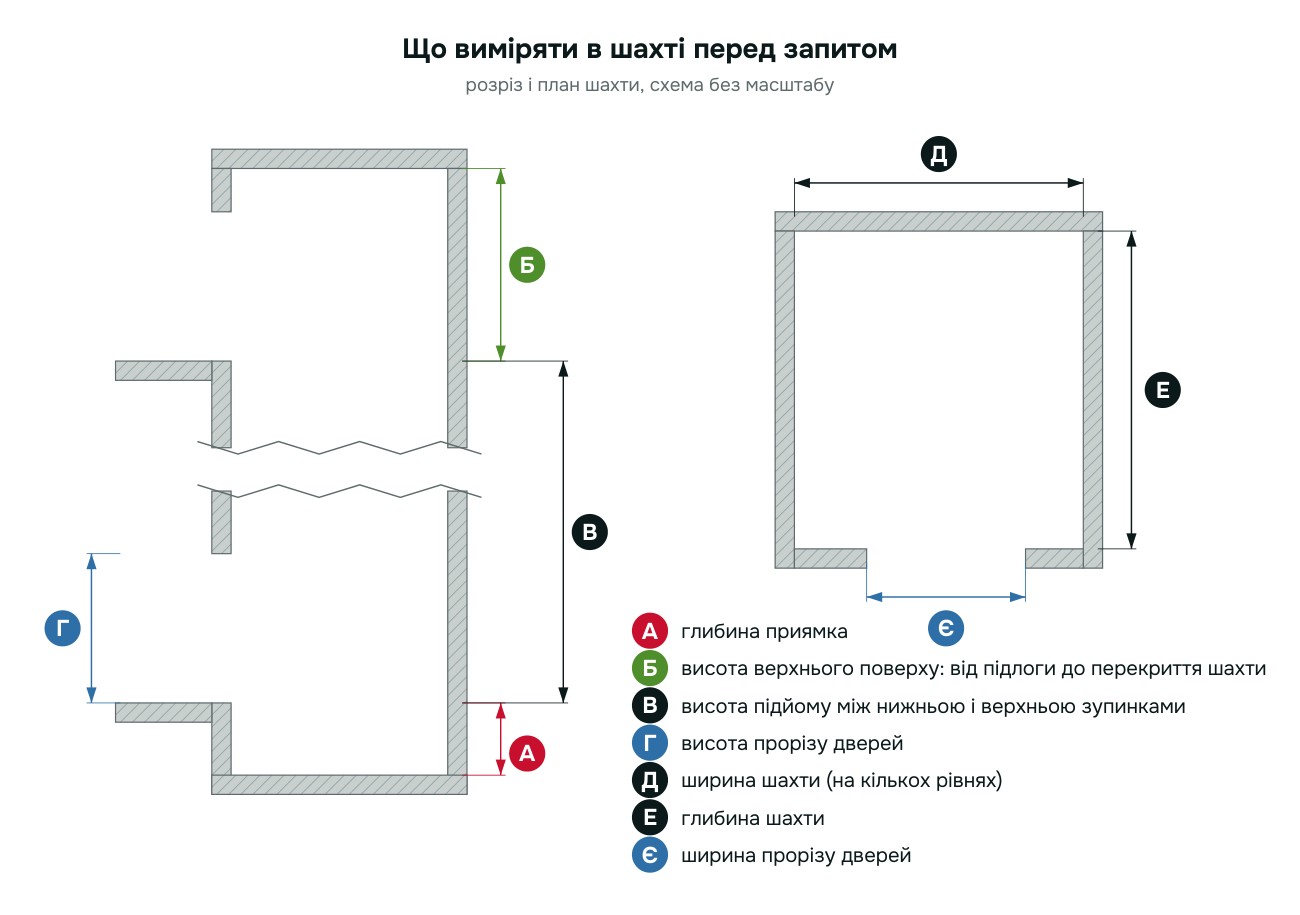
For a lift with a shallow pit three figures matter most: the pit depth that can be achieved, the height from the top landing floor to the slab above, and the finished plan dimensions of the shaft. The shaft width should be measured at several levels, because in old buildings the walls are rarely plumb. Photos of the pit and the top of the shaft and information about what lies beneath the shaft are also useful.
Building requirements
- The shaft is not part of the supply. The client builds or prepares it to the factory's drawing; the factory supplies anchor rails and lifting hooks to be cast in or fixed.
- The temperature in the shaft and near the controller cabinet must be between +5 and +40 °C. The warranty does not cover moisture and contamination.
- Supply voltage fluctuations of up to ±10% are permitted.
- Space for the controller cabinet is needed in the reveal of the opening next to the lowest-floor door.
- Emergency communication requires mobile network coverage in the shaft, a SIM card and an alarm call centre to receive the calls.
The factory requires maintenance to be carried out in accordance with EN 13015; without proper maintenance the warranty obligations do not apply.
Rescue operation without power
Diethelm's standard method is gravity-based. The counterweight balances the car plus 42% of the rated load. When the power fails, the car moves under control to the nearest reachable floor in the direction the mass difference pulls it: an empty or nearly empty car goes up, a loaded one goes down.
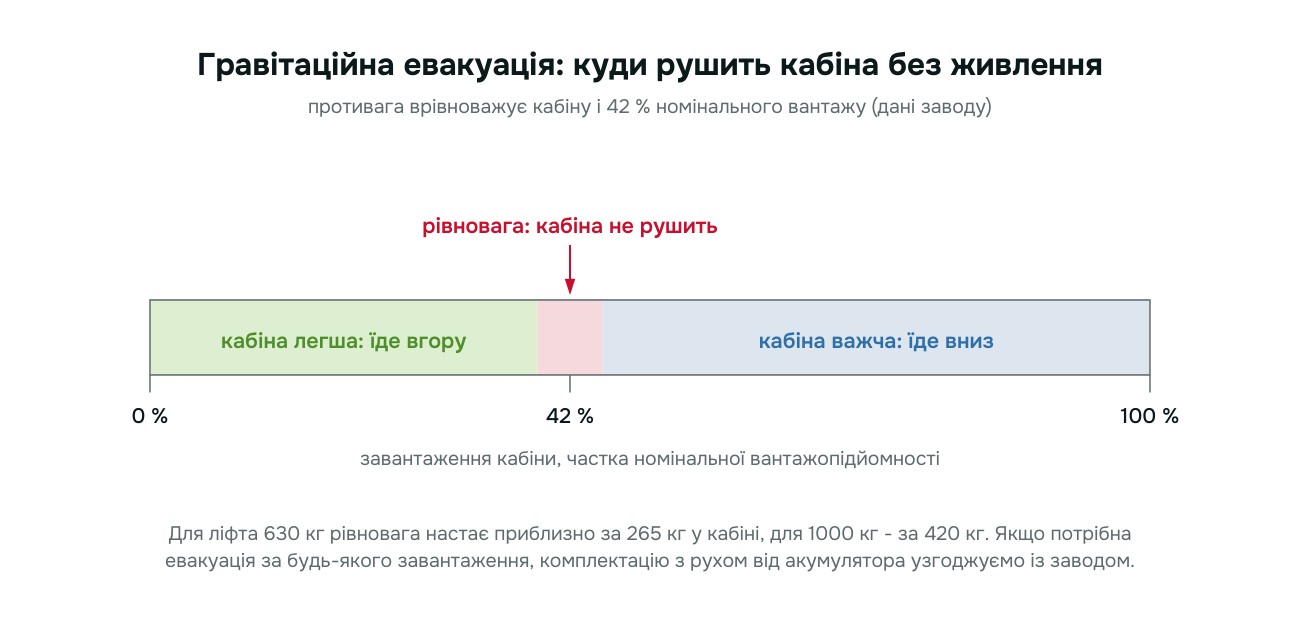
The limitation follows from the physics itself. If the car carries about 42% of the load, that is roughly 265 kg in a 630 kg lift or 420 kg in a 1000 kg lift, the masses are equal and the car will not move. The controller stops the attempt on a timer, and the passengers wait for the power to return or for a technician. The factory warns about this explicitly. A configuration with battery-powered rescue, in which the motor brings the car to a floor, is agreed with the factory separately for each lift.
Customer questions
Is a 150 mm pit really enough?
That is the value in the factory's quotation for a 630 kg lift in a 1600 × 1750 mm shaft. For any other shaft only the factory's drawing confirms it. If 450 mm can be provided, that is what the factory advises. More on the shallow pit page.
Is the lift suitable for a new building?
The reduced pit and headroom are designed to the standard for existing buildings. In a new building the shaft is designed with conventional dimensions, and the factory calculates the lift for those.
What documents are required in Ukraine?
The factory has no type-examination certificate for the lift as a whole: the safety components are certified, and each lift is accepted individually. That is why we carry out conformity assessment under the Technical Regulation on Lifts on site for each lift; it requires the factory's technical documentation and the certificates for the safety components.
Who installs the lift?
We carry out the installation and commissioning. The factory's quotation covers only manufacturing and handing over the equipment at the factory.
Can the car finishes be changed?
The side wall colour, the floor and the door material are chosen during configuration. Once the drawing is approved, changes already affect production.
What is the warranty?
Under the terms of the factory's quotations, two years from handover of the equipment at the factory. The warranty does not cover wear, the effects of moisture, voltage fluctuations beyond the tolerance or third-party interference.
You can send the shaft dimensions through the lift request form; the on-site survey is free.
